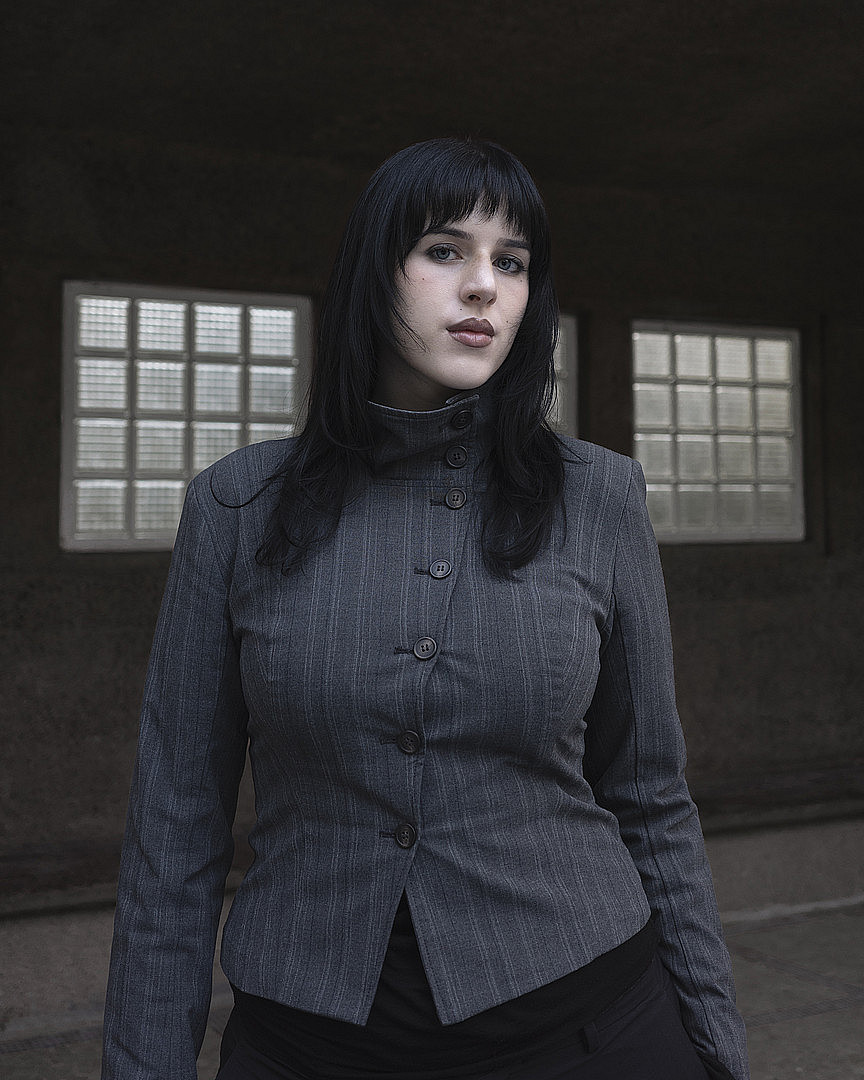
Around 64 artistic and design perspectives, a shared exhibition space, and the question of how diverse paths can intersect: As curator of EXAMEN 2026 (9 to 13 December), Emily Pretzsch is devising a presentation exploring time, becoming and orientation.
“I have a preference for exhibitions featuring many artists. I’m a maximalist myself, including in the way I curate,” she says, explaining her motivation for curating this year’s degree show at the Kunsthochschule Kassel. What appeals to her about group exhibitions is the opportunity to let different artistic worlds coexist side by side and to discover new perspectives. “The documenta Hall is a place where I can experiment with space and explore curatorial possibilities,” says the art historian enthusiastically. To this end, she is developing a simplified model of the documenta Hall in which she is testing various spatial configurations: what does a work need to unfold? Light or darkness, silence or sound, proximity or distance? It will be the largest project she has curated to date.
‘Until Due Time’ is the subtitle of this year’s EXAMEN. At the heart of the concept lies the English word ‘due’. It refers to a point in time when something is due or expected. In the phrase ‘due north’, it also takes on a spatial meaning, describing a precise direction towards the north. Pretzsch draws on this ambiguity to explore ideas of development and orientation: how much time does something need to come into being, and when does its direction change?
With the end of their studies, the graduates’ individual developmental processes reach a provisional milestone. They demonstrate where they currently stand and the direction in which their creative work might develop. “University life offers special conditions for making art and trying things out. Afterwards, a lot changes,” says Pretzsch. She sees the final presentation as a moment on a threshold: an opportunity to consciously bring a phase to a close and celebrate it, without already determining what lies ahead. “Artistic processes rarely follow a straight path. Some take detours, others consolidate, or start all over again. In the exhibition, these different paces should be allowed to coexist,” she emphasises.
The challenge lies in bringing together around 64 independent contributions from the fields of art and design into a unified whole, without reducing them to a single narrative. Unlike in a traditional group exhibition, the participating works have already been selected. Usually, Pretzsch first develops a theme and then invites artists whose works she incorporates into the concept through dialogue. With EXAMEN, the starting point is the reverse: “The various positions have already been established. It is only through engaging with them that I develop a theme capable of encompassing this diversity,” she explains.
The curatorial practice of the Berlin-based art historian is shaped by her engagement with collaboration. She began curating alongside others at an early stage and views the conception of exhibitions as a process that emerges through dialogue. For this current project, she first wishes to familiarise herself as thoroughly as possible with the graduates’ contributions. Through on-site and online studio visits, in discussions, and by examining drawings and texts, she engages with their ideas and working methods. She is interested not only in the finished works, but equally in the individual processes from which they emerged. “I’d like to see a collaboration in which both sides can contribute something,” says Pretzsch. Spatial considerations and new questions can arise from the exhibitors’ ideas. Mutual trust is a prerequisite for this. She wishes to respect the decisions of those involved whilst also bringing her own perspective to bear. Closeness and independence need not be mutually exclusive.
Her many years’ experience in art education also inform the planning process. Pretzsch is interested in the experiences visitors bring with them and how they can find personal ways of engaging with the works on display: “Who visits an exhibition, what experiences do people bring with them, and how can they engage with the works? A final-year exhibition offers many opportunities to forge such connections,” she explains.
In previous projects, the curator has focused on diverse perspectives on the world. Her areas of interest include mythology, temporality, becoming and development, dreams and desires, as well as science fiction and posthumanist approaches. She explores the traces people leave behind on Earth, the stories they tell about themselves, and who can shape these narratives. “Storytelling as a cultural practice fascinates me greatly, particularly when considering the context in which art is exhibited,” Pretzsch points out.
These questions also shape her understanding of curation. With EXAMEN – Until Due Time, she aims to create a space in which experiences and perspectives can coexist and engage with one another without losing their autonomy. “As a curator, I must continually open myself up to different ways of thinking and different practices. That requires attention and a willingness to change my own ideas as well.” From 9 to 13 December 2026, a dialogue will unfold between the works on display in the documenta Hall, whilst each individual piece is simultaneously given the freedom to speak for itself.
Emily Pretzsch (born 2000) is an art historian and curator based in Berlin. Her work centres on collective authorship, speculative world-building and the poetic dimensions of narrative. Starting from questions about temporality, fiction and possible futures, she explores – in close collaboration with contemporary artists – the stories we tell and the traces we leave behind in the process. She studied cultural, technological and art history at the Technical University of Berlin, as well as curatorial studies at the Städelschule and Goethe University Frankfurt.
(Text in German: Çiğdem Özdemir)
Further information: