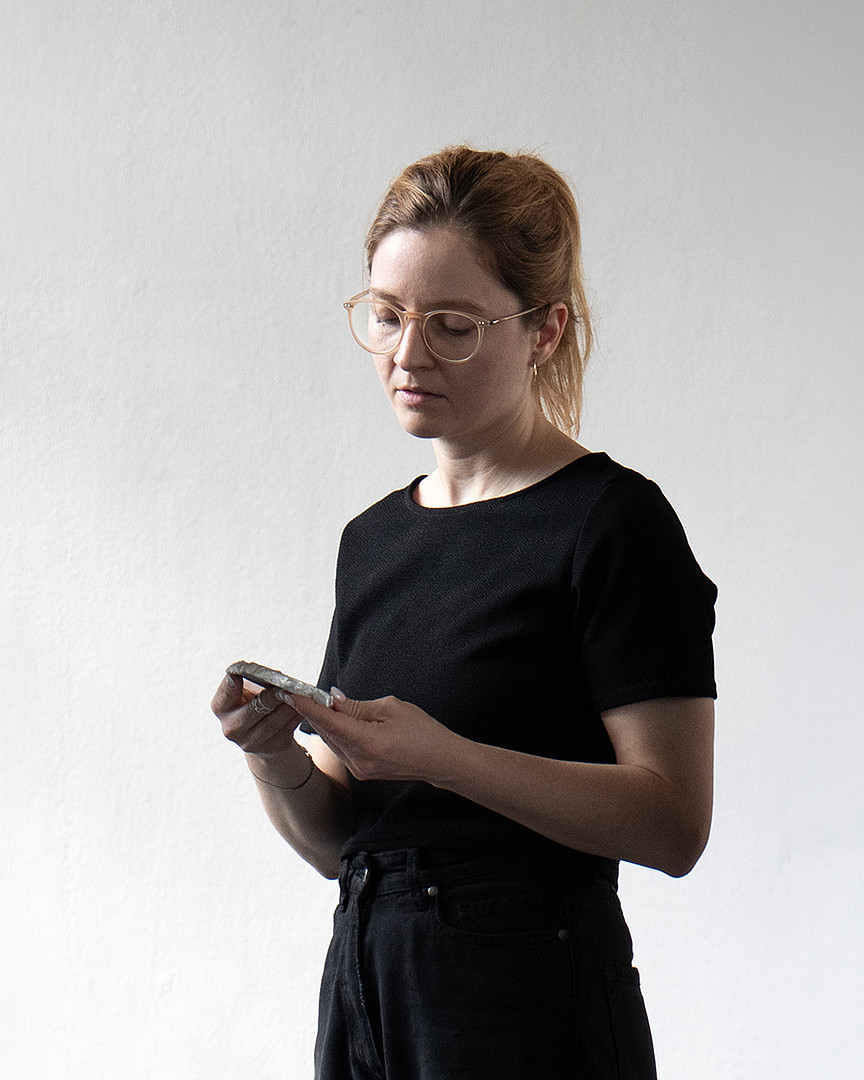
Natascha Burk, an artist-in-residence at the Kassel Art Academy, speaks in the ‘KhK im Gespräch’ series about her experimental approach to design, the importance of physical model-making, and the interplay between analogue working methods and artificial intelligence. The interview was conducted by Çiğdem Özdemir.
What drives you in your work as a designer, and what questions are you currently exploring?
Two themes that recur in my artistic practice are imitation and adaptation. I am interested, for example, in how one material can be represented by another, or how a technique developed for a specific application can be transferred to a new context. At the moment, I’m exploring the digital adaptation of craft techniques as well as industrial joining and manufacturing processes. In doing so, I’m investigating how the principles of analogue techniques can be reinterpreted using digital technologies, and what creative possibilities this opens up.
How does an initial idea become a concrete design, and what role do research and experimentation play in this?
My approach is exploratory and process-oriented. It often begins with an interest in a particular material or technique. Through research and practical experimentation, this develops into a concept for the design. Although I am experienced in using CAD, physical model-making plays a major role in my design process, whether using paper and card or 3D printing. This is how I check whether my ideas regarding scale, proportions and function hold up. Model-making allows me a different kind of reflection, during which I often discover possibilities I hadn’t thought of before.
What experiences from your own practice shape what you pass on to students in your teaching?
From my own practice, I know that the design profession involves more than just designing. Communicating your own work clearly, documenting projects and bringing them to life are just as important. I want to pass this on to my students and show them the different paths they can take as aspiring designers.
In my foundational teaching, I combine the learning of key tools and methods with practice-based tasks. These provide guidance whilst also leaving room for individual approaches and experimentation. In this way, students gradually develop confidence in the design process as well as an independent and reflective creative approach.
By sharing insights into processes and issues from my own professional practice, I aim to give students a realistic picture of the profession. I see this exchange as a two-way process: topics from my professional practice feed into my teaching, whilst working with students provides new inspiration for my own creative work.
AI in design: How is artificial intelligence changing the role of designers?
In my experience, AI mostly generates the obvious and the predictable. This can certainly be practical, for example when it comes to drafting an email or retouching a photograph. For me, however, a design proposal becomes interesting when it surprises or reveals new connections – for example, between two topics or disciplines that, at first glance, appear to have nothing to do with one another.
That is why, in my view, AI cannot replace the individual observations that shape a design. The same applies to the experiences gained through physical work and handling materials, when something is created that cannot be planned in advance. I rely on such experiences in my own practice, and this is what I also aim to convey in my teaching. The more AI becomes a matter of course in the design process, the more important it becomes for me to develop my own questions and to engage in process-oriented, analogue working.
About Natascha Burk
Natascha Burk is a product designer and, since 2022, has been an artistic assistant to Prof. Lutz Pankow in the Foundation Course in Design at the Kassel Art Academy. In her design practice, she combines industrial design with experimental form-finding. In her furniture and object designs, she explores materials, processes and technologies, and applies familiar principles to unfamiliar contexts.
Alongside her teaching role at the art academy, she works freelance with companies and studios and pursues her own independent projects. Her designs are represented, amongst others, by the Berlin-based label Successful Supper. Her work has most recently been exhibited at the Museum für Kunst und Gewerbe in Hamburg, the Ars Electronica Festival in Linz, the Dresden Design Days, Paris Design Week and the Currents Berlin design festival.
As part of the ‘Casting Agency’ collective, she collaborates with designers Friederike Wübbeler and Lisa Wübbeler to explore how experimental casting techniques shape the formal characteristics of objects made from pewter and other materials.
Further information on Natascha Burk:
nataschaburk.com
About the ‘KhK im Gespräch’ series
The ‘KhK im Gespräch’ series introduces the artistic and academic staff of the Kassel Art Academy. The focus is on their individual working methods, current projects and research approaches, as well as their commitment to teaching and research. This highlights the diversity of perspectives and ideas that contribute to the further development of the Kassel Art Academy.