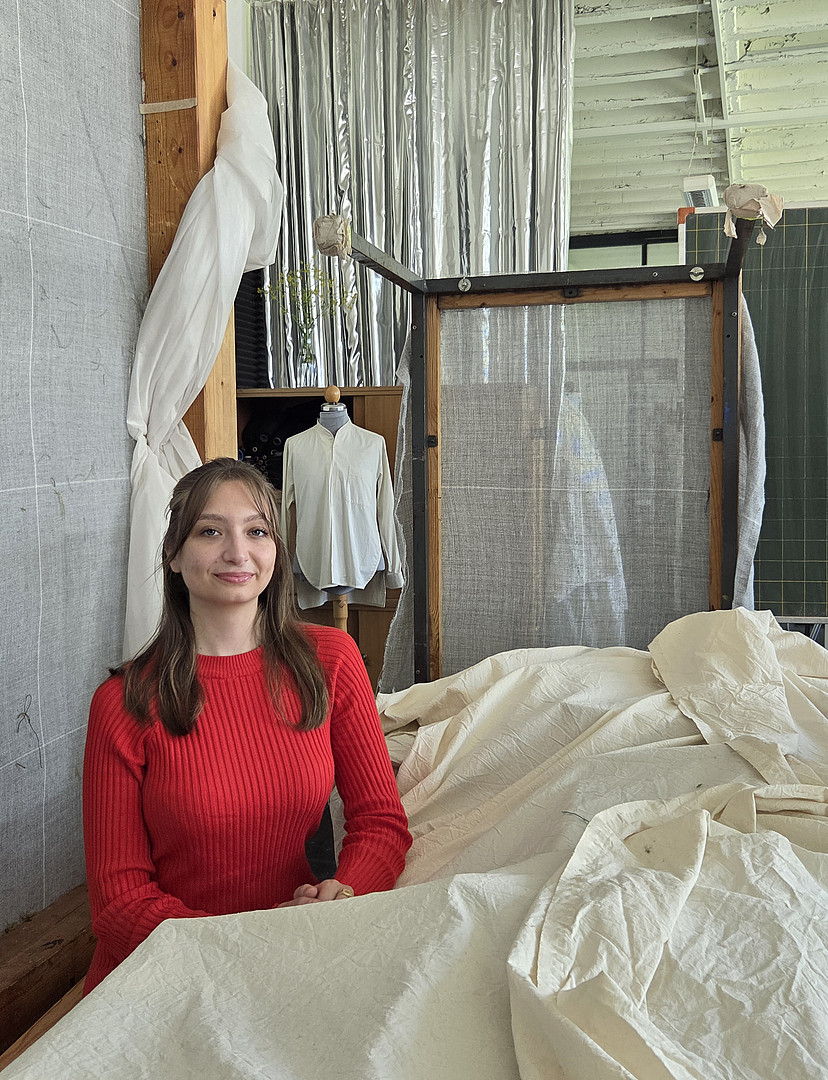
Design student Indira Marukić creates products inspired by various cultures. “I am fascinated by the idea of placing historical traditions within a contemporary context and reinterpreting them in my work. In my ‘Lametta’ stool, for example, I draw on Roman design and rework it. The white, curved shape echoes the design language of Roman stools. The pink leather fringes allude to Roman helmets, though deliberately in a modern interpretation,” explains the art student. Whether it be form, colour or proportion, Marukić attempts to reinterpret design elements, sometimes through reduction, sometimes by highlighting a specific detail, or by using a different material. ‘Misappropriation’ can be very helpful in this regard, she says ironically.
The rich culture of Bosnia, where Marukić’s family comes from, particularly the blend of Oriental and European influences, shapes her design thinking. “It inspires me greatly that in Sarajevo, a piece of the Orient can be found right in the heart of Europe. I’m less interested in the motifs often on display – such as floral embroidery – than in everyday behaviours and subtle design details,” says the design student. Her approach to cultural themes has changed over the course of her studies: “At the beginning, I drew more heavily on stereotypical imagery such as traditional geometric carpet patterns. Today I pay more attention to gestures, customs and everyday practices. For example, coin jewellery with embossed designs is part of historical or folkloric clothing styles in many regions of the Balkans. It is worn on special occasions,” emphasises Marukić. The coin jewellery is not only decorative but also carries symbolic meaning. The act of wearing jewellery, which makes ethnic identity visible, serves as a source of inspiration for the product designer’s own creative concepts. “With my work, I want not only to draw on the aesthetics of past eras, but also to bring them into dialogue with the present.” Her “DUKAT” ring design thus explores the significance of coin jewellery whilst also offering a new interpretation of an ancient motif with a long tradition.
As a designer, Marukić aims to build a bridge between different cultures. At the same time, she is conscious of her social responsibility. For her, design is more than aesthetics or functionality: “Design decisions influence how people perceive things. They can make certain values visible or reinforce them. That is why design is not neutral, but always part of social processes. Design objects can be used as a political medium to challenge established power structures,” Marukić points out. In doing so, she draws on the discourse of design theorist Friedrich von Borries, who emphasises the close connection between design and politics and notes that design is rarely neutral. Design objects can be used socially, interpreted politically or instrumentalised. This gives designers a responsibility to reflect on the consequences and potential uses of their designs.
This year, Marukić aims to complete her studies under Prof. Ayzit Bostan. As a designer, she wishes to develop solutions to current challenges. She is particularly interested in how traditional techniques and materials can be adapted to a contemporary context, thereby creating sustainable alternatives. “Design can help tackle social problems, for example when you think of terracotta vessels that cool water without any electricity at all,” says the aspiring designer, pointing to the potential of traditional techniques for sustainable solutions.
(Text in German: Çiğdem Özdemir)