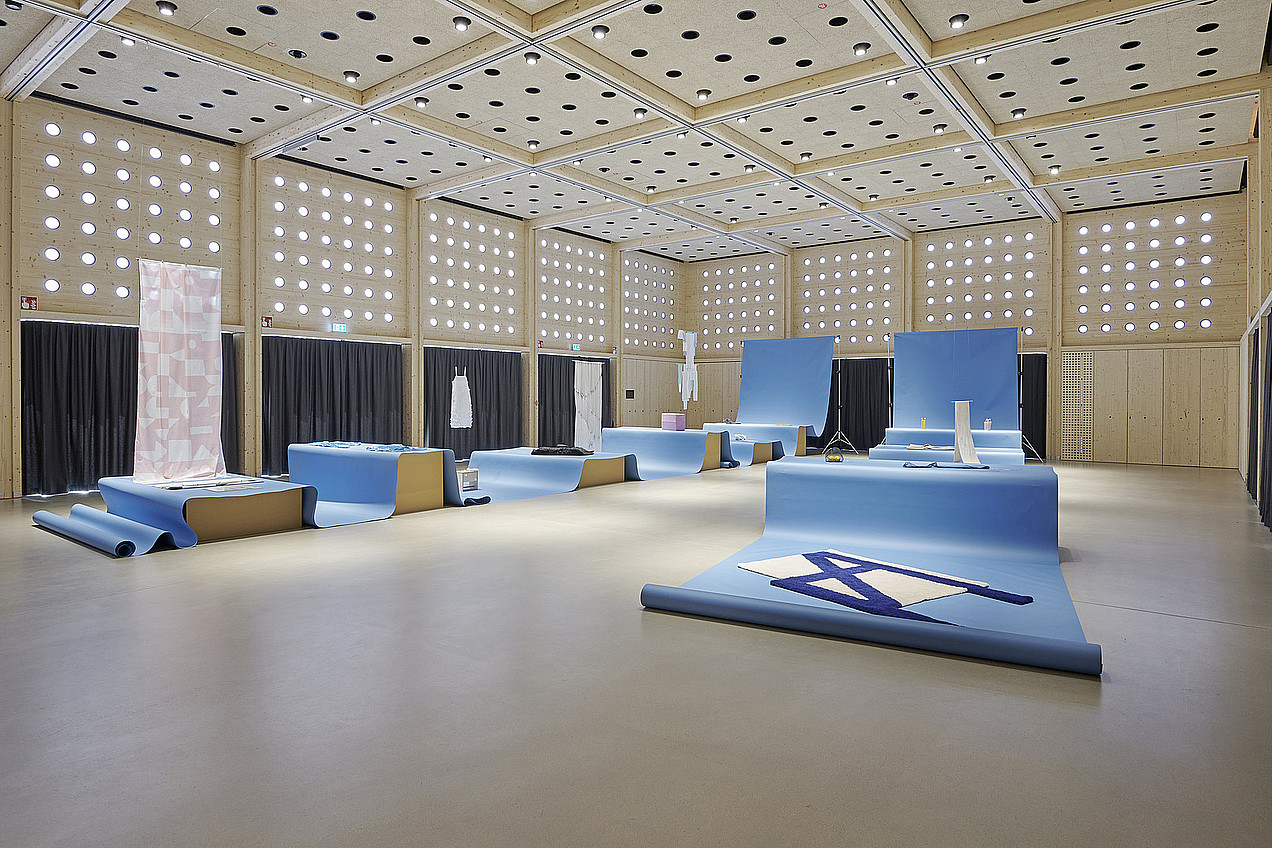
The new Research Training Group ‘Dimensions of Exhibiting: Displays, Politics, Infrastructures’ will begin investigating the world of exhibitions as a global phenomenon on 1 April 2027. The DFG is funding this interdisciplinary research project with around 4.9 million euros. This was announced today (16 November 26).
The Research Training Group will examine the wide-ranging field of tension within which exhibitions are situated. The basic hypothesis is that exhibiting is a highly dynamic relational practice. Exhibitions are not limited to museums or galleries, nor to the field of art. Rather, exhibiting can be understood as a form of public articulation that manifests itself in various fields, ranging from science and history to urban development, political commemoration and digital environments. Exhibitions can be examined in terms of their characteristics, for example with regard to the specific ways in which objects and narratives are selected, staged, framed, activated and communicated to the public.
The exhibition sector is understood as a ubiquitous global phenomenon. The worldwide proliferation of exhibition formats such as biennials or globally marketed art fairs has created a dense network connecting artists, curators and audiences across continents. At the same time, exhibitions spark debates and serve as arenas where conflicting social values are negotiated. One example is the debate on anti-Semitism in connection with documenta fifteen in 2022.
The planned Research Training Group ‘Dimensions of Exhibiting’ takes a two-pronged approach: on the one hand, it aims to train the next generation of researchers and curators. At the same time, the research aims to bring together various disciplines and generate the knowledge needed to understand today’s constantly evolving exhibition landscape. “We invite innovative PhD projects from the fields of art history, architecture, design, sociology, cultural studies and related disciplines that critically engage with exhibition practices in diverse contexts,” says Prof. Dr Alexis Joachimides of the Kassel Art Academy, who acts as spokesperson for the Research Training Group.
The interdisciplinary approach is reflected in the participating departments and fields of study, with overlaps occurring with two thematically significant institutions: the documenta Institute and TRACES:
- Kassel Art Academy: Prof. Dr Alexis Joachimides (Modern Art History); Prof. Dr Susanne Ritzmann (Sustainable Product Design and Development); Prof. Dr Martin Schmidl (Art History and Aesthetics)
- Department of Architecture, Urban Planning and Landscape Architecture: Prof. Dr Gabu Heindl (Architecture, City and Economy); Prof. Dr Philipp Oswald (Architectural Theory and Design); Prof. Dr Felix Vogel (Art and Knowledge)
- Department of Social Sciences: Prof. Dr Mi You (Art and Economies)
The documenta Institute brings together the humanities, social sciences, artistic research and cultural studies within a long-term research framework dedicated to exhibitions and their social contexts. Closely linked to this is TRACES: the Transdisciplinary Research Centre for Exhibition Studies was founded in 2019 as an inter-faculty research platform at the University of Kassel. Since 2022, TRACES has been organising an ongoing programme of public and academic events at its own research station on Lutherplatz in Kassel.
The Research Training Group will run for nine years and begins on 1 April in the documenta year 2027. The German Research Foundation (DFG) is funding it with approximately 4.9 million euros.
Source:
www.uni-kassel.de